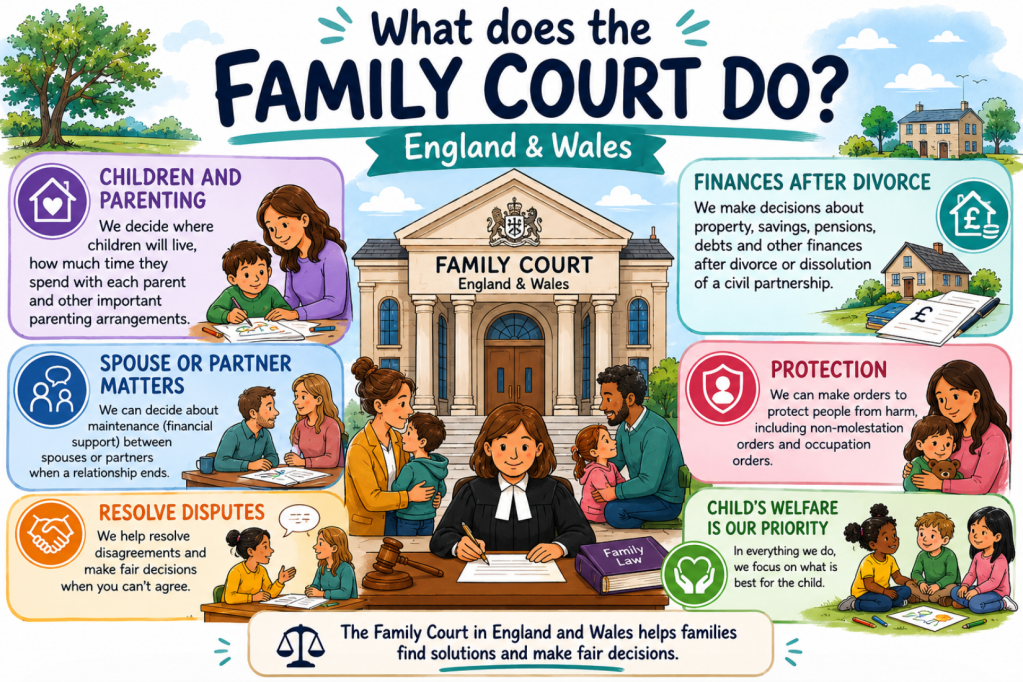
The family justice system exists to help families resolve disputes arising in respect of family matters quickly and with the minimum of disruption to those involved.
In many cases, the parties are encouraged to resolve their family disputes out of court, for example through mediation, unless this is not a safe course. This approach is taken because outcomes are more likely to be successful if the parties themselves have had a role in planning and agreeing that outcome.
Types of cases in the family court:
- Cases about marriage and civil partnerships
- Cases about divorce and separation
- Cases about finances after divorce or separation
- Protection from domestic abuse and coercive and controlling behaviour (Injunctions)
- Arrangements for children
- Child protection
- Adoption
- International abduction
- Forced marriage
- Female genital mutilation
- Cases under the Inherent Jurisdiction – this can include decisions about medical treatment or withdrawal of medical treatment and issues regarding publication
- Cases about parentage – for example where children are born by way of surrogacy
Children cases in the family court
Children cases coming before the family court mainly involve two broad categories of work: private and public.
Private cases are disputes that involve parents or other family members and concern their children, for example, in divorces or separations. These cases are often about issues such as who the children should live with, who they should see, where they should go to school or even if they can move to live abroad with one of their parents. Orders that set out who a child should live with and who they should spend time with are called ‘Child Arrangements Orders’.
Public work is the term used for cases when the local authority (social services) brings a case to court because the child or children are being harmed or are at risk of being harmed in some way. These are cases where the local authority is asking the court to make a ‘Care Order’ or ‘Supervision Order’. In some cases the local authority might be recommending that a child or children is adopted – applications to place a child for adoption and for adoption orders are also heard in the Family Court. (Not all public law proceedings lead to adoption applications.)

